
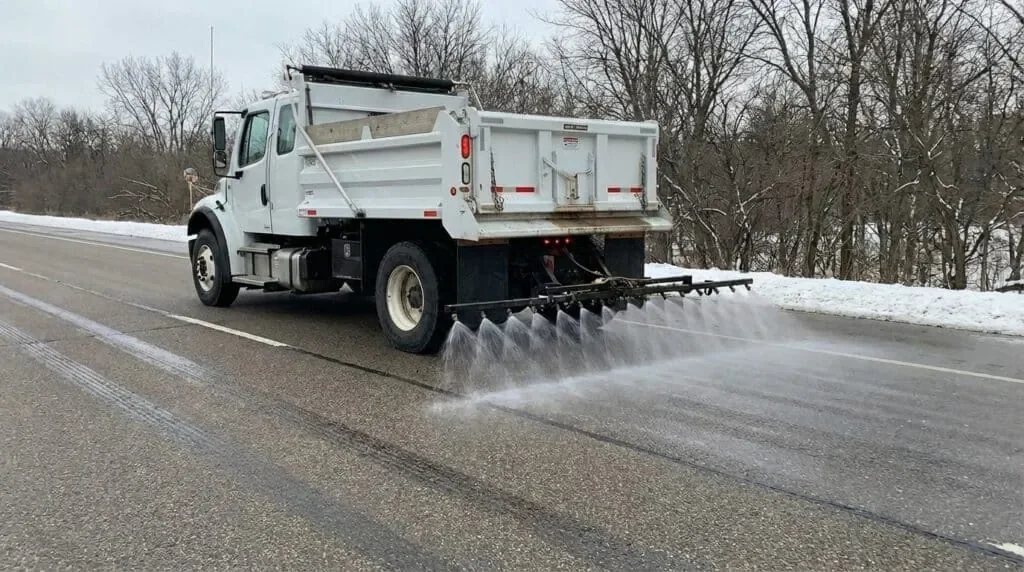
Yes. Road brine is a salt and water mixture, and the chlorides in it corrode the steel frames, wiring and metal fittings on a fleet truck if they stay there. Crews put brine down before ice or snow arrives, so a truck can pick it up on a road that still looks dry. The fix is simple: rinse the undercarriage soon after exposure, use hot water and detergent, and wash on a schedule that matches how often your trucks drive through treated roads.
Does Road Brine Damage Fleet Trucks?
It does. The Idaho Transportation Department's 2014 study of salt and salt brine found that all chloride deicers are corrosive, and that in laboratory tests sodium chloride is consistently among the most corrosive. The same report found that in one modified test, brine was roughly equally corrosive at 1.5%, 3% and 6% concentrations. A weaker mix is not a harmless one.
Commercial Carrier Journal reports that deicing chemicals left on a truck corrode the chassis, metal components and wiring. Gerry Mead, Hub Group's executive vice president of maintenance and equipment, told the magazine that the corrosion starts when salt gets wet and breaks down. The article also warns that deicers left on a chassis dry out and become reactive again each time they get wet. One trip over treated pavement can keep doing damage long after the trip if nobody washes it off.
Fleet Equipment magazine adds that road chemicals cling to undercarriages and hold moisture, which makes them more corrosive. It also says winter traction and deicing materials create a "sandblast" effect that wears away protective coatings.
What Is Road Brine, and When Does It Go Down?
TxDOT describes brine as a salt and water mixture that can be applied several days ahead of an event so ice does not bond to the road surface. In a November 2024 article, TxDOT said crews winterize roads by applying brine "ahead of freezing temperatures and precipitation."
That matters for fleets because the exposure comes before the storm. A truck can drive through brine on a clear afternoon and be parked in your yard with it still on the frame when the front arrives.
Here in the Big Country, the National Weather Service lists Abilene's average first autumn freeze as November 11 and its average last spring freeze as March 21. That puts the freezing season at roughly four months, and brine goes down around specific forecasts, not every day. TxDOT's Abilene District runs winter operations of its own. A March 2023 district brief describes a pilot that tracks where brine is sprayed, sand is spread and roads are plowed on four vehicles in the district.
If your trucks stay on local routes, you may see brine only a few times a winter. A truck that runs routes where winter weather is more common will pick up more.
Which Parts of a Fleet Truck Take the Damage?
The parts that are hardest to see and hardest to reach are the ones that suffer. Jack Lennon, who oversees Blue Beacon Truck Wash operations, says washing the outside of a truck will not remove chemicals and salt from the frame, junction boxes, couplers and other hard-to-reach areas.
Frame and chassis: Deicing chemicals left on the truck corrode the chassis and other metal components (Commercial Carrier Journal).
Wiring and junction boxes: Chemicals corrode wiring, and junction boxes are a spot exterior washing misses (Commercial Carrier Journal).
Couplers and trailer landing gear: Road chemicals may affect these parts, among others (Commercial Carrier Journal and Fleet Equipment).
Suspensions and structural members: Road chemicals may affect them (Fleet Equipment).
Protective coatings on the underbody: Traction material and deicers create a sandblast effect (Fleet Equipment).
How Often Should You Wash Fleet Trucks in Winter?
There is no official schedule. The carriers quoted by Commercial Carrier Journal tie it to exposure. Jim Dillon of Gemini Motor Transport says his company washes equipment at least weekly, and on routes with heavy chemical use it may wash two or three times a week. Lennon recommends washing soon after salts and chemicals stop being applied to the road, rather than waiting for a calendar date.
Here is a rule of thumb built from those two points. It is a starting point, not an industry standard.
Local routes, no brine on the road: Keep your normal wash schedule.
Drove through a treated area once or twice: Rinse the undercarriage, frame and couplers soon after, instead of waiting for the next routine wash.
Regular winter routes through treated roads: Wash at least weekly.
Routes with heavy chemical use: Wash two or three times a week.
After the last treatment of the season: Do one full wash, including the undercarriage.
How Do You Wash Road Brine Off a Fleet Truck?
Wash soon after exposure. The faster deicing agents come off the undercarriage and other metal parts, the better off the truck is long term, according to PPG's Scott Colvin in the Commercial Carrier Journal article.
Use hot water and detergent. Lennon says "a combination of detergents and hot water is really what is needed," and that cold water alone is unlikely to remove road chemicals.
Reach the hidden spots. Spray up into the frame rails, around junction boxes, couplers and landing gear, not just the paint.
Match the pressure to the job. Fleet Equipment recommends low to mild pressure and thorough rinsing. The Idaho report notes that a Washington State study found low-pressure washing was usually effective, but salt bonded to metal may need ultra-high-pressure water jetting.
Rinse thoroughly. Mead says the wash must be rinsed well so no residue stays behind.
Check your recycled water. If your wash bay recycles water, Mead's warning applies: "You have to check the salt content of your recycled water." Otherwise you can wash salt right back onto the truck.
The Idaho report is honest about the limits. It notes that washing facilities are not available everywhere, that manual washing is impractical in winter, and that some in the trucking industry see the washing recommendation as shifting maintenance costs to users. If you have no good wash bay of your own, a mobile service that comes to the yard is one way around that.
Frequently Asked Questions
Is a weaker brine mix safer for my truck? Not by much, going by one test. The Idaho report found brine roughly equally corrosive at 1.5%, 3% and 6% concentrations in a modified laboratory test.
Will rain or a quick exterior rinse take care of it? Probably not. Deicers left on a chassis dry and become reactive again whenever they get wet, and an exterior wash does not reach the frame, junction boxes and couplers.
Should I use a pressure washer on the frame? Use low to mild pressure for routine rinsing. Salt that has been bonded to metal for a long time may need much higher pressure, which is a job for trained crews and the right equipment.
Is washing the only defense against corrosion? No, but it is the one you control. The Idaho report found that many deicer corrosion inhibitors that pass laboratory tests did not reduce corrosion in the field, and it notes that agencies often recommend regular vehicle washing.
When should we do the spring wash? Soon after the last brine application of the season. Abilene's average last spring freeze is March 21, so late March is a reasonable date to put on the maintenance calendar.
Need Help Washing Brine Off Your Fleet?
West Texas Pressure Services washes commercial trucks, trailers and utility vehicles, and cleans heavy equipment. Our fleet washing service covers exterior washing, undercarriage cleaning and degreasing, with flexible scheduling. Our earlier posts on commercial fleet washing in Abilene and fleet washing in San Angelo explain what a regular program looks like.
To set up a winter wash schedule, request a quote or call (325) 977-1585.
Sources
Commercial Carrier Journal. "Need a simple, effective method to fight corrosion? Wash the truck." March 29, 2019 (updated April 19, 2022). https://www.ccjdigital.com/truck-washing-a-simple-effective-method-to-fight-corrosion
Fleet Equipment. "Corrosion protection improves equipment lifespan." Publication date not shown. https://www.fleetequipmentmag.com/corrosion-protection-improves-equipment-lifespan/
Idaho Transportation Department (FHWA-ID-14-231, prepared by CTC & Associates LLC). "Impacts of Using Salt and Salt Brine for Roadway Deicing." June 2014. https://rosap.ntl.bts.gov/view/dot/28516/dot_28516_DS1.pdf
National Weather Service. "Freeze Climatology." https://www.weather.gov/sjt/climate-freezeinfo
Texas Department of Transportation. "Statewide winter readiness means preparations, partnerships." November 12, 2024. https://www.txdot.gov/about/newsroom/stories/2024/statewide-winter-readiness-means-preparations-partnerships.html
Texas Department of Transportation. "TxDOT prepares for winter weather." Publication date not shown. https://www.txdot.gov/about/newsroom/stories/txdot-prepares-for-winter-weather.html
Texas Department of Transportation, Abilene District. "Weather Responsive Management Strategies." March 2023. https://www.txdot.gov/content/dam/docs/programs/abilene-weather-responsive-mgmt-strategies-fy22.pdf
